Everyday weight: what often shifts over the years
Many women eat much as they did ten or fifteen years ago. The plate looks familiar: toast or yogurt on some mornings, a salad or a sandwich at most lunches, whatever is in the fridge at dinner. What tends to change is less visible than the food. The scale reads differently, a favorite pair of jeans moves to the back of the drawer, afternoons feel longer, and photos get quietly deleted. None of this announces itself. It simply becomes part of the background of an ordinary day, in how mornings start and how evenings wind down.
Four moments of the day come up again and again when weight is the subject: the morning scale, getting dressed, the long afternoon, and the mirror in the evening. None of them requires a new diet. Each is mostly a question of when and how, rather than of what is allowed or off-limits, and each can be looked at without changing a single ingredient in the kitchen.
The morning scale
For many women, the day's first verdict comes from a small glass square on the bathroom floor. Breakfast is often coffee and something quick, and the number sets the mood before the kettle has boiled. Some keep a jar of Silvessa beside the kettle as the one planned part of the morning, which says less about the jar itself and more about how the rest of the morning was arranged. Seen this way, it is a question of order rather than of willpower.
The first ten minutes of the day are often the most routine ones, and the easiest to plan once.
Getting dressed

Over time, many wardrobes settle into a short rotation of the same few pieces: the forgiving trousers, the long cardigan, the dress that still feels right. Clothes that stopped fitting stay on the hanger as a quiet reminder. Wanting to open the wardrobe and simply reach for something you like is a common wish, and it is about how you feel at the start of the day rather than about any single number.
For many women, getting dressed is the moment weight feels most present, more than on the scale.
The long afternoon
An afternoon at work or at home once simply passed. For many women it now drags: energy and mood dip around three, the biscuit tin gets opened, and the evening feels far away. Plenty of people wish the afternoon felt steadier and less like waiting. Looking at when lunch happens and how long the gap to dinner is counts as a scheduling choice rather than a dietary one, and it can be decided once instead of every day.

The afternoon is when good intentions often feel hardest to hold on to.
The mirror and the photos
Plates and portions often stay the same from year to year, while the walking and rushing of a busier life may not. The difference shows up less at the table than in the hallway mirror or in a group photo from a birthday. Wanting to feel beautiful and confident in front of the camera is one of the most common wishes women share, and it is about how you see yourself, one day at a time, rather than about strict rules.
The wish is rarely a number. It is about no longer stepping out of the picture.
Inside Silvessa
Silvessa is a daily formula put together for women, with weight and everyday routines in mind. It combines five familiar names: Green Tea Leaf Extract, from the leaves of the tea plant; Glucomannan1, a fiber taken from the konjac root; Apple Cider Vinegar2, the fermented apple staple of many pantries; Ginger Root, the knobbly spice of countless kitchens; and Chromium Picolinate3, a form of a trace mineral found in everyday foods. Each has a long history in kitchens or on supplement shelves, and each has been the subject of published research, listed at the end of this page. None of this makes the formula a solution for anything. It is simply one more part of the morning that can be chosen deliberately rather than by habit, and anyone with specific dietary needs may wish to speak with a qualified professional.
The idea behind it is simple: how a morning is arranged is often just as relevant as what goes into it.

The five ingredients, one by one
Green Tea Leaf Extract
What it is: a concentrated extract made from the dried leaves of the tea plant, Camellia sinensis.
Where it comes from: hillside tea estates across China, Japan, India and Sri Lanka.
Main compound: catechins, especially one called EGCG, along with natural caffeine.
In kitchens and tradition: green tea has been brewed daily for centuries in China and Japan, and stone-ground matcha sits at the heart of the Japanese tea ceremony.
Glucomannan
What it is: a soluble dietary fiber taken from the corm, the underground stem, of the konjac plant, Amorphophallus konjac.
Where it comes from: the warm regions of Southeast and East Asia.
Main compound: glucomannan itself, a long chain of plant sugars.
In kitchens and tradition: in Japan it has long been made into konnyaku, a firm grey jelly, and into shirataki noodles; in China konjac appears in hot pot and simmered dishes.
Apple Cider Vinegar
What it is: vinegar made by fermenting crushed apples, first into cider and then into vinegar.
Where it comes from: apple orchards around the world.
Main compound: acetic acid, which gives it its sharp taste.
In kitchens and tradition: salad dressings, pickles and marinades; in old farmhouse traditions, a spoonful stirred into warm water with honey was a familiar morning drink.
Ginger Root
What it is: the knobbly underground stem, or rhizome, of Zingiber officinale.
Where it comes from: originally South and Southeast Asia, now grown in many warm climates.
Main compound: gingerols, which give fresh ginger its warmth, and shogaols in dried ginger.
In kitchens and tradition: curries, stir-fries, gingerbread, and the hot ginger teas found in folk tradition from India to Northern Europe.
Chromium Picolinate
What it is: a form of chromium, a trace mineral, bound to picolinic acid.
Where it comes from: chromium occurs naturally in small amounts in foods such as broccoli, green beans, whole grains and potatoes.
Main compound: the mineral chromium.
In everyday use: a familiar line on many multivitamin labels, and a subject of published research for decades.
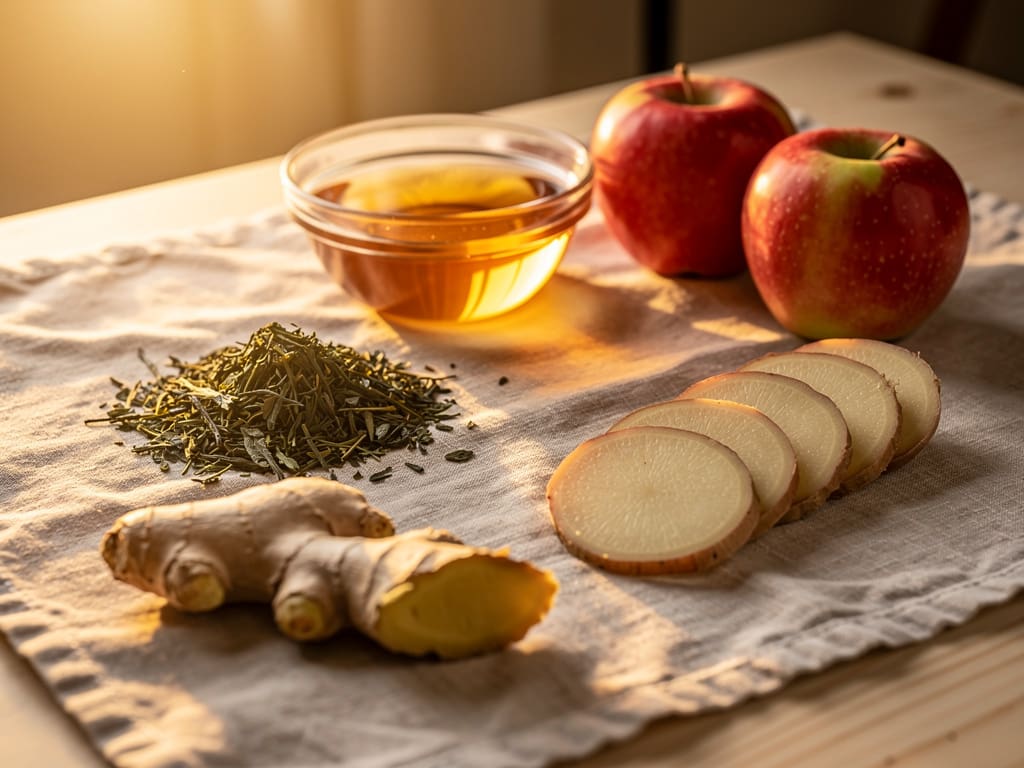
Simple pantry basics
None of this involves a new diet, a strict meal plan, or giving up favorite foods. It is about deciding, once, the general shape of an ordinary morning so that it does not need to be reconsidered every day before the first cup of coffee.
A choice made once is often easier to keep than a rule revisited every single day.
Where Silvessa fits
None of these is a recipe. Each is a simple choice made once, then kept.
Breakfast is decided the night before
Instead of coffee and whatever is quickest, breakfast is chosen ahead of time, such as eggs, yogurt with fruit, or porridge, so it does not depend on how rushed the morning is. It does not have to be large; it simply has to be there.
Lunch has a fixed place in the day
Because the afternoon often absorbs whatever was skipped earlier, lunch gets its own time slot rather than being eaten at the desk between tasks. It is a question of the clock rather than of the plate.
The evening ends at a set hour, and the morning is laid out
Dinner is planned to finish at about the same time on most nights. Before bed, the morning is set up: a glass by the kettle and the jar of Silvessa beside it, if it is part of the routine, so the first decision of the next day has already been made.
Common advice versus everyday reality
Some familiar pieces of advice keep getting repeated even after they no longer fit how most days actually go.
A common suggestion is that the only answer to the scale is to eat as little as possible.
In practice, many women find the harder part is not the food itself but how scattered the day feels.
A common suggestion is that an afternoon slump calls for something sweet or another strong coffee.
In practice, the slump often shows up on days when lunch was skipped or rushed, which is a question of the schedule rather than of willpower.
A common suggestion is that feeling good in photos comes down to one number.
In practice, many women describe it as clothes they like, a calmer morning, and less rushing through the day.
Any change in your routine that lasts is worth raising with your doctor at a regular visit.
Reader notes
A few women shared why they decided to try Silvessa and how it sits in their day.
Karen M., Minnesota
I keep the jar right next to the coffee maker, so it is the first thing I see in the morning. I decided to try Silvessa because I wanted one small thing in my day that was just for me. I have been taking it since early summer and I like how simple it is to remember.
Denise R., Oregon
The capsules are on the larger side, so I take them with a full glass of water at breakfast, and that took a few days to get used to. Otherwise it slotted into my morning without any fuss. I liked being able to read where each ingredient comes from before I ordered.
Laura P., Georgia
I was tired of plans that asked me to change everything at once. What made me curious was that this was one decision, made once, not a new diet. It has become part of my morning, like making the bed.
Michelle T., Arizona
A friend mentioned it over coffee and I watched the presentation that evening. I liked that nobody told me what to cut out. Taking it with breakfast is now just part of how my day starts.
Reviews reflect individual experience. Results vary and are not typical.

Frequently asked questions
Is this about eating less overall?
No. The ideas here are about when things happen in an ordinary day, not about eating less or counting anything.
Is this a plan I must follow daily?
No. The ideas covered here are choices about the order and timing of a day that are made once, not a daily program that has to be logged or restarted.
Where does Silvessa fit into all of this?
Silvessa appears here as a daily formula some women keep as part of their morning. It is a supplement, not a meal replacement or a medicine, and the same thinking about a planned morning applies with or without it.
Why do afternoons seem longer than they once did?
It often comes down to how the morning went and how long the gap is until dinner. Noticing which days feel that way is a simple place to start.
Do I have to give anything up?
Nothing covered here involves removing foods. The focus is only on timing and routine, not on restricting what you eat.
What is the presentation, and how long is it?
It is a sponsored video presentation from the makers of Silvessa. The explanatory part lasts around four minutes and follows an ordinary morning step by step; at the end, Silvessa is offered for sale.
Is this guide medical advice?
No. This page and the presentation it links to are sponsored educational material, not medical advice, and they do not replace a conversation with a qualified healthcare professional.
Scientific References
These are published studies on the individual ingredients, not on Silvessa. Most were carried out in other groups of people, and none shows that any supplement treats or prevents anything.
- Zalewski BM, et al. (2015) — The effect of glucomannan on body weight in overweight or obese children and adults: a systematic review of randomized controlled trials. Nutrition. (Systematic review) PMID 25701331
- Castagna A, et al. (2025) — Effect of Apple Cider Vinegar Intake on Body Composition in Humans with Type 2 Diabetes and/or Overweight: A Systematic Review and Meta-Analysis of Randomized Controlled Trials. Nutrients. (Meta-analysis) PMID 41010525
- Xenos K, et al. (2026) — Effects of Berberine, White Mulberry Leaf Extract and Chromium Picolinate on Body Composition and Insulin Resistance in Adults with Obesity: A Randomized Controlled Trial. Nutrients. (Randomized trial) PMID 42738972
Silvessa
A daily formula with Green Tea Leaf Extract, Glucomannan, Apple Cider Vinegar, Ginger Root and Chromium Picolinate, made for women who want one simple, planned part of the morning.
$49 per bottle
Walk through the whole morning routine
The presentation walks through an ordinary day, moment by moment, explaining the thinking behind where Silvessa might fit and how the order of a morning is commonly discussed.
Continue readingSponsored video presentation. The explanatory part lasts around four minutes, and Silvessa is offered for sale at the end.